
Why AI Fails Without Trusted Data


Artificial Intelligence (AI) is transforming how companies manage business partner data. AI agents validate records, enrich profiles, detect anomalies, and propose updates at a speed and scale that manual processes cannot match. The promise is real: faster onboarding, fewer errors, lower cost.
But there is a problem that no amount of AI can solve on its own. When the underlying data is inconsistent, incomplete, or poorly governed, automation does not fix things. It makes them worse. AI amplifies whatever it receives. Feed it clean, well-structured data, and it accelerates your operations. Feed it fragmented records and conflicting signals, and it spreads errors across every system it touches.
Key takeaways
- AI amplifies data quality, good or bad. Clean data accelerates operations. Poor data spreads errors at scale.
- AI models cannot validate authoritative sources, enforce governance policies, or resolve jurisdictional classifications on their own.
- Trusted data requires provenance, authoritative sourcing, and governance policies, not just correct-looking values.
- Data cleansing must be continuous, not a one-time project, because business partner records change constantly.
- Governed automation, combining rule-based services, AI, and human oversight, is what separates durable results from expensive experimentation.
The AI Overestimation Trap: Why Models Cannot Fix Bad Data on Their Own
AI models have strict context limits. They lack domain logic for jurisdiction-specific regulations, identifier formats, and legal form classifications. They cannot reliably distinguish between authoritative registry data and weak web signals. And they cannot enforce governance policies they do not know about.
Consider a concrete example: a business partner record lists a VAT number and a legal form. An AI agent can check whether the format looks plausible. But it cannot confirm registration with the tax authority. It cannot verify that the legal form matches the jurisdiction's official classification. And it cannot decide, based on your company's policies, whether a low-confidence match should be auto-applied or routed for human review. These are precisely the decisions that determine whether your data is trustworthy, and they require structured rules, authoritative sources, and governance frameworks that sit outside the model.
The Hidden Risk: AI Amplifies Data Quality Issues
Not every task benefits from AI in the first place. Geocoding, tax number validation, identifier format checks, and registry lookups produce better results through deterministic services with verifiable, reproducible rules. AI adds real value in fuzzy matching, evidence synthesis, and research tasks, but only when it operates alongside structured methods, not as a replacement for them. A hybrid approach is essential because no single method covers all needs.
The same applies to the belief that more agents and more automation automatically produce better outcomes. Without governance, scaling agents leads to conflicting actions, duplicated effort, and inconsistent updates. One agent proposes an address change based on a web signal, another overwrites it with registry data, and a third flags the conflict but has no policy to resolve it. Quality only improves when automation is aligned with clear policies and authoritative sources.
Organizations that skip this step and jump straight to AI-driven automation without establishing data readiness often find themselves in a downward spiral. Exceptions multiply. Rework increases. Downstream processes break. The response is typically more automation on top of the same bad data, which only deepens the problem.
What Trusted Data Means for AI: Definition and Requirements
Trusted data is not just data that looks correct. It is data with provenance: you know where it came from, when it was last verified, and which rules were applied. It is data backed by authoritative sources: official business registers, tax authorities, and regulatory filings. Plus, it is data governed by clear policies that define confidence thresholds, approval paths, and escalation rules.
For business partner data, this matters enormously. Identifiers like tax numbers, legal entity identifiers, and registration codes must be validated against the issuing authority, not just checked for format. Legal forms must reflect the jurisdiction's actual classifications. Addresses must be geocoded and normalized against reference databases.
When this foundation is in place, AI becomes genuinely powerful. Agents can detect changes, propose updates, compare signals from multiple sources, and flag discrepancies, all with full traceability. Every proposed change carries evidence: source, timestamp, confidence level, and the policy that triggered it.
Without that foundation, AI operates in the dark. It guesses. It hallucinates. And it does so at scale. Explore how continuous data cleansing builds the foundation for AI-ready business partner data. Join our AI webinar series.
Why Data Cleansing Is the Starting Point for AI, Not an Afterthought
Many companies treat data cleansing as a periodic project: a one-time cleanup before a migration or a system rollout. Run a matching exercise, deduplicate the records, fix the obvious errors, and move on. That approach made sense in a world where data was mostly static and processes were manual.
In an AI-driven world, data cleansing becomes continuous. Business partner records change constantly: companies merge, relocate, rebrand, or go bankrupt. Regulatory requirements shift. New identifiers are introduced. If your data is not continuously validated and enriched, it drifts out of sync with reality, and your AI agents inherit that drift.
Effective data cleansing in the age of AI means:
- Establishing clean, validated baselines against authoritative sources
- Monitoring records for changes on an ongoing basis
- Building the governance layer that keeps data correct over time, not just fixing records once
This is where many organizations need to start. Not with the most advanced AI use case, but with the fundamentals: are your business partner records accurate, complete, and continuously maintained? If not, every AI initiative that depends on that data carries risk.
Governed Automation: The Real Differentiator for AI in Data Management
The organizations that succeed with AI in data management are not necessarily the ones with the most sophisticated models. They are the ones that combine AI with deterministic services, structured governance, and human oversight where it matters.
This means:
- Using proven, rule-based services for structured checks: geocoding, identifier validation, registry lookups
- Applying AI where interpretation, fuzzy matching, or evidence synthesis is needed
- Staging proposed changes in a controlled environment before they reach production systems
- Keeping humans in the loop for ambiguous cases, policy decisions, and exception handling
The result is a model where speed and quality reinforce each other instead of competing. Agents run continuous checks and enrichments in the background. High-confidence updates flow into operations automatically. Low-confidence proposals get routed for review. Every action is traceable: source, rule, timestamp, decision.
Think of it as continuous delivery of trusted data. Domain agents gather signals from registries, web sources, and internal systems. They check those signals against rules and authoritative references, then assemble structured update proposals in a safe staging area. Only validated changes move forward into production. The entire chain is transparent, auditable, and governed by the policies your organization defines, not by the model's best guess.
This shift also changes what data management teams do. Rather than correcting records manually, they define trusted sources, set quality thresholds, and establish approval paths. They decide which data must meet near-perfect accuracy and which use cases tolerate lower precision. They interpret conflicting evidence from multiple registries, resolve ambiguity, and adapt policies when regulations change. The human layer remains essential, not for routine updates, but for judgment, stewardship, and decisions under uncertainty.
This is not a futuristic vision. It is how leading organizations are already working with their business partner data. And it is what separates durable AI value from expensive experimentation.
Two Futures: What Happens Next Depends on the Foundation
There is an optimistic scenario and a pessimistic one. Both are already playing out across different organizations.
In the optimistic scenario, an organization has invested in clean baseline data, clear ownership, and robust governance policies. Agents access high-quality internal data and authoritative external sources. They operate under transparent rules for confidence, provenance, and approval. Routine maintenance, enrichment, and monitoring tasks are largely automated.
Remaining data experts focus on exceptions, policy design, and collaboration with business stakeholders. Because agents run continuously and at scale, they catch more issues than human teams ever could. Quality and speed improve together, and trusted data becomes a structural advantage, accelerating onboarding, reducing compliance risk, and enabling AI initiatives that actually deliver.
In the pessimistic scenario, automation is introduced on top of inconsistent, incomplete, or poorly governed data. Agents lack access to authoritative sources, operate on conflicting records, and are not constrained by clear confidence thresholds or approval rules. AI models hallucinate details to fill gaps. Conflicting signals are resolved ad hoc, without traceable policies or human review.
Over time, data teams are reduced on the assumption that automation has taken over, but the remaining staff cannot keep up with the volume of low-quality changes. Downstream processes experience more exceptions, rework, and disputes. Management responds with more automation on top of the same bad data, which only deepens the problem. Costs rise, trust declines, and data loses its value as a reliable basis for decisions.
The difference between these two futures is not the sophistication of the AI. It is the quality of the foundation.
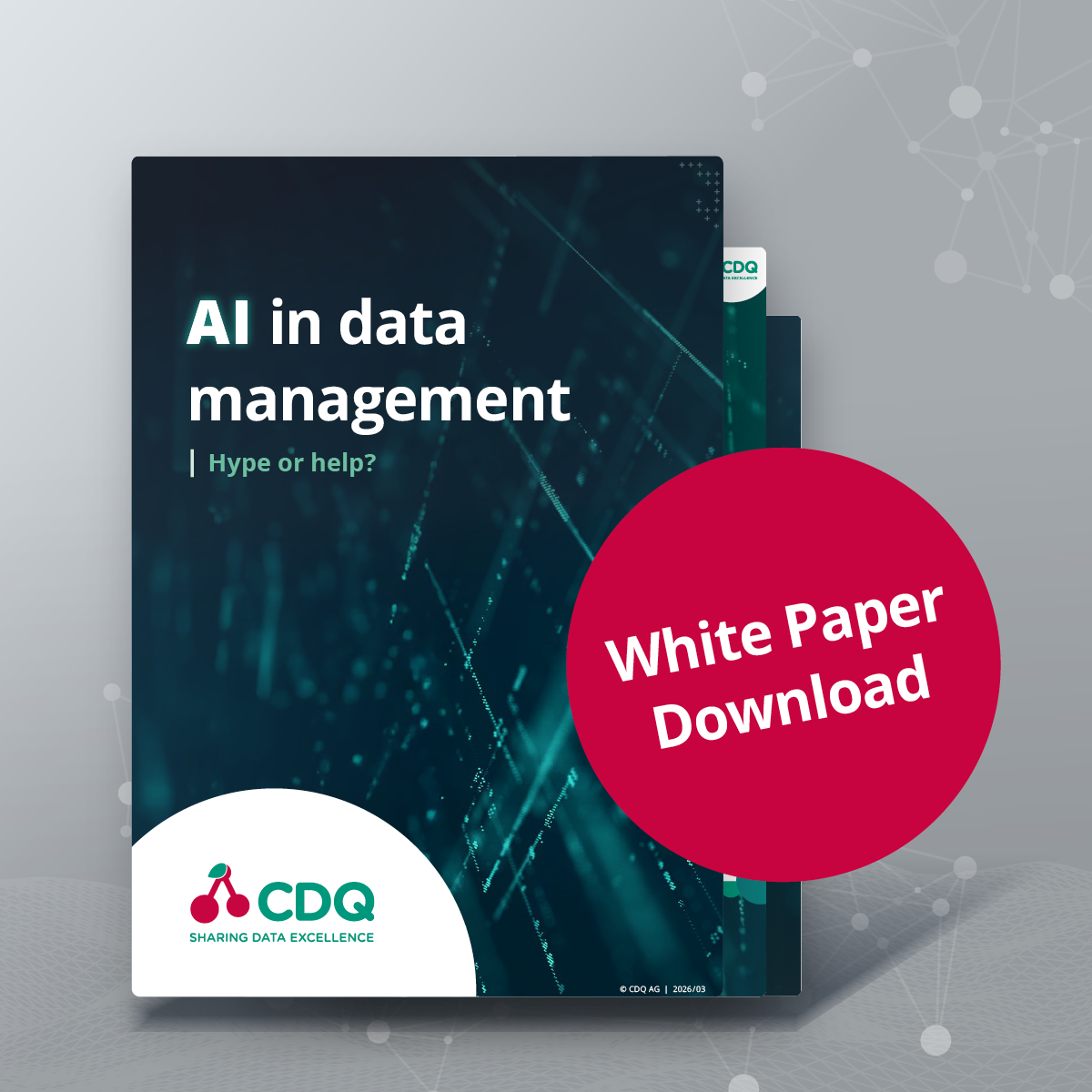
Download our AI whitepaper to understand how trusted data, governance, and agentic AI work together.
How Data Sharing Multiplies AI Data Quality Across the Network
There is one more dimension that individual company efforts cannot address alone. Business partner data is, by nature, shared across organizations. Your suppliers are someone else's customers. Your customers have relationships with your competitors. Changes to a company's registration, address, or legal status affect everyone who does business with them.
When organizations contribute validated updates to a governed data sharing community, the entire network benefits. Patterns emerge faster. Risks surface earlier. Changes to a supplier's registration status or a customer's legal form reach every affected partner without delay. And the quality of shared intelligence exceeds what any single company could achieve through its own efforts.
This shared intelligence becomes especially valuable for AI. Instead of each organization's agents independently crawling the same registries and web sources, they benefit from a collective signal landscape: pre-validated, enriched, and continuously updated. It is the difference between each company building its own weather station and having access to a shared satellite network.
How to Build AI-Ready Data Infrastructure: Next Steps
AI will continue to reshape data management. The question is not whether to adopt it, but how to adopt it in a way that produces reliable, auditable, and lasting results.
The answer starts with AI data readiness:
- Clean baselines: validate existing records against authoritative sources before automation begins
- Authoritative sources: connect to official business registers, tax authorities, and regulatory filings
- Governance policies: define confidence thresholds, approval paths, and escalation rules
- Continuous monitoring: detect changes in real time so AI agents always work from current data
These are not just nice-to-have foundations. They are the preconditions for AI that compound quality over time instead of compounding errors. Organizations that invest here first will find that AI accelerates their advantage. Those who skip this step will keep spending more to fix the consequences.
The technology is ready. The question is whether your data is. CDQ helps organizations build that foundation by combining authoritative reference data, continuous monitoring, data sharing intelligence, and governed automation so that AI initiatives deliver results you can depend on.



Get our e-mail!
Related blogs

Why next generation of enterprises will be data-first, not AI-first
AI is only as good as the foundation supporting it. Discover why forward-thinking enterprises are prioritizing clean, accessible data over AI models to drive…

8 Things CDOs should know about cloud data quality
Migrating to the cloud amplifies existing data quality issues. Without proactive governance, bad data multiplies faster across distributed cloud environments,…

What Is AI-Ready Data?
A Practical Definition (and Checklist) for Enterprise Teams. AI-ready data is not the same as clean data, and that distinction is why so many AI initiatives…