
From Ideas to Everyday Practice: Reflections from a Data Management Conference in Amsterdam

Attending a European data management conference in Amsterdam offered a valuable opportunity to step outside daily project work and look at how organizations across industries are actually progressing with master data initiatives. Not in theory, not in slideware, but in everyday operational reality.
What stood out immediately was the tone of the conversations. This was not an event dominated by abstract strategies or future promises. Instead, practitioners spoke openly about what works, what takes time, and where even well-designed concepts still struggle once they meet organizational reality. From executive sponsorship to governance models and operational rollout, the focus was consistently on translating intent into practice without overwhelming the business.
For us at CDQ, these exchanges were particularly relevant, as many of the challenges discussed closely mirror what we see in our work with customers and partners across Europe.
From “Why” to “How”: Data Management Through a Human Lens
One recurring theme shaped many of the discussions: while the rationale for data governance and the available frameworks are largely understood, implementation remains a human challenge. Organizations are built around people, not policies.
A sentence that resonated strongly throughout the sessions captured this reality succinctly:
Everybody needs data governance, but nobody wants to be governed.
The implication was clear. Successful data initiatives require more than sound models and tooling. They demand empathy, flexibility, and a communication style that focuses on value creation rather than control. Several speakers emphasized that the language used internally can determine whether data governance is perceived as an enabler or an obstacle.
A Practical Customer Perspective: Covestro
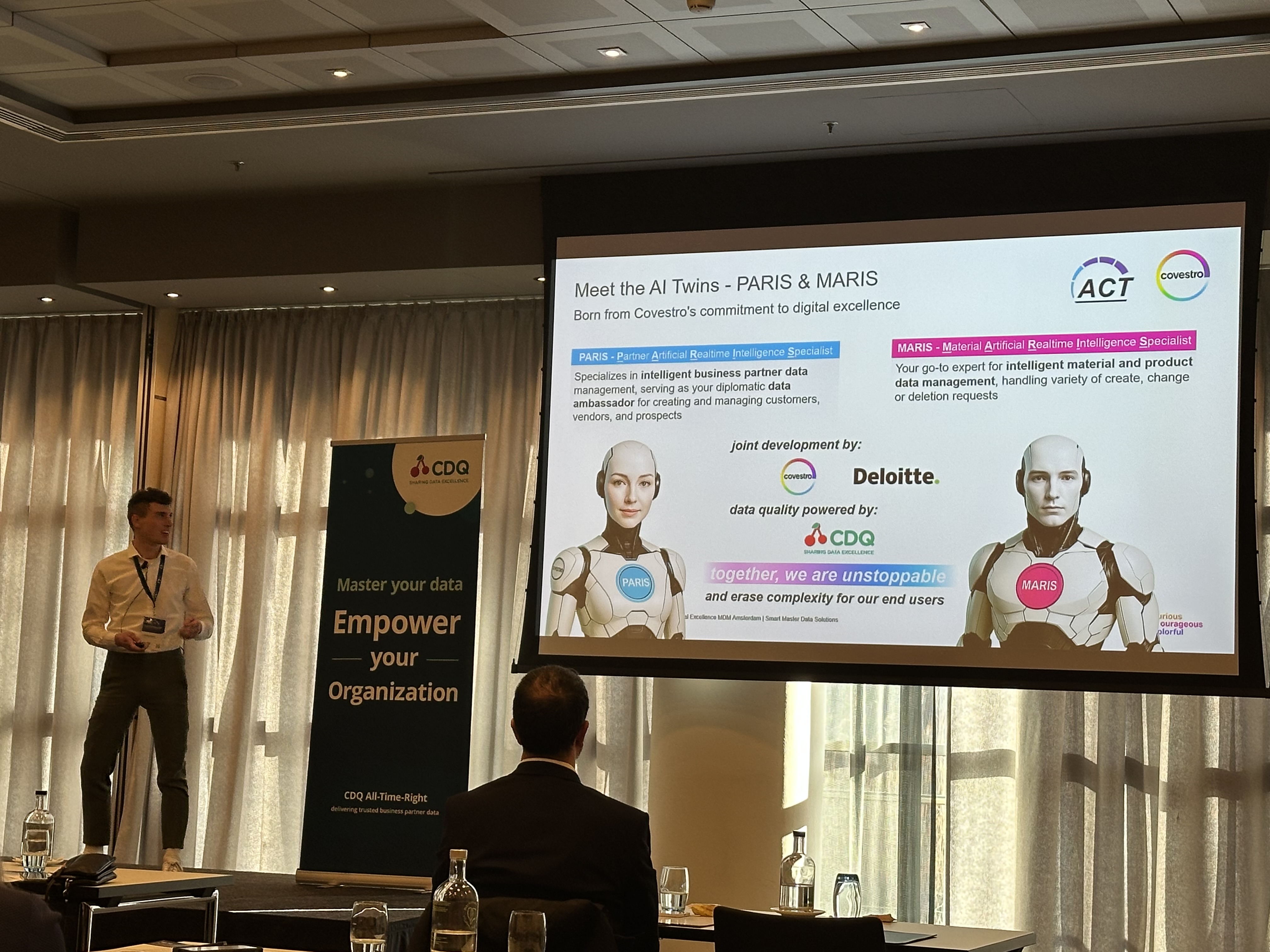
In my opinion one of the most concrete contributions came from Covestro, who shared how they approach business partner onboarding at scale. Their presentation focused on designing processes that are both efficient and accessible, rather than optimized solely for data specialists.
The demonstration showed how standardized onboarding can significantly reduce manual effort and accelerate downstream processes. However, the discussion went beyond efficiency alone. A key point was that the process was deliberately designed to be usable by a broader audience. By lowering complexity and making responsibilities clearer, data quality becomes a shared task rather than a centralized bottleneck.
A notable element of the Covestro's project was the use of AI-driven chatbots that support users in navigating business partner and material data. Instead of adding complexity, AI was applied to remove friction, shorten processing times, and reduce errors in day-to-day SAP interactions.
This combination of structure and inclusiveness resonated strongly with participants and sparked meaningful discussion around sustainable adoption.
Different Levels of Maturity, Shared Challenges
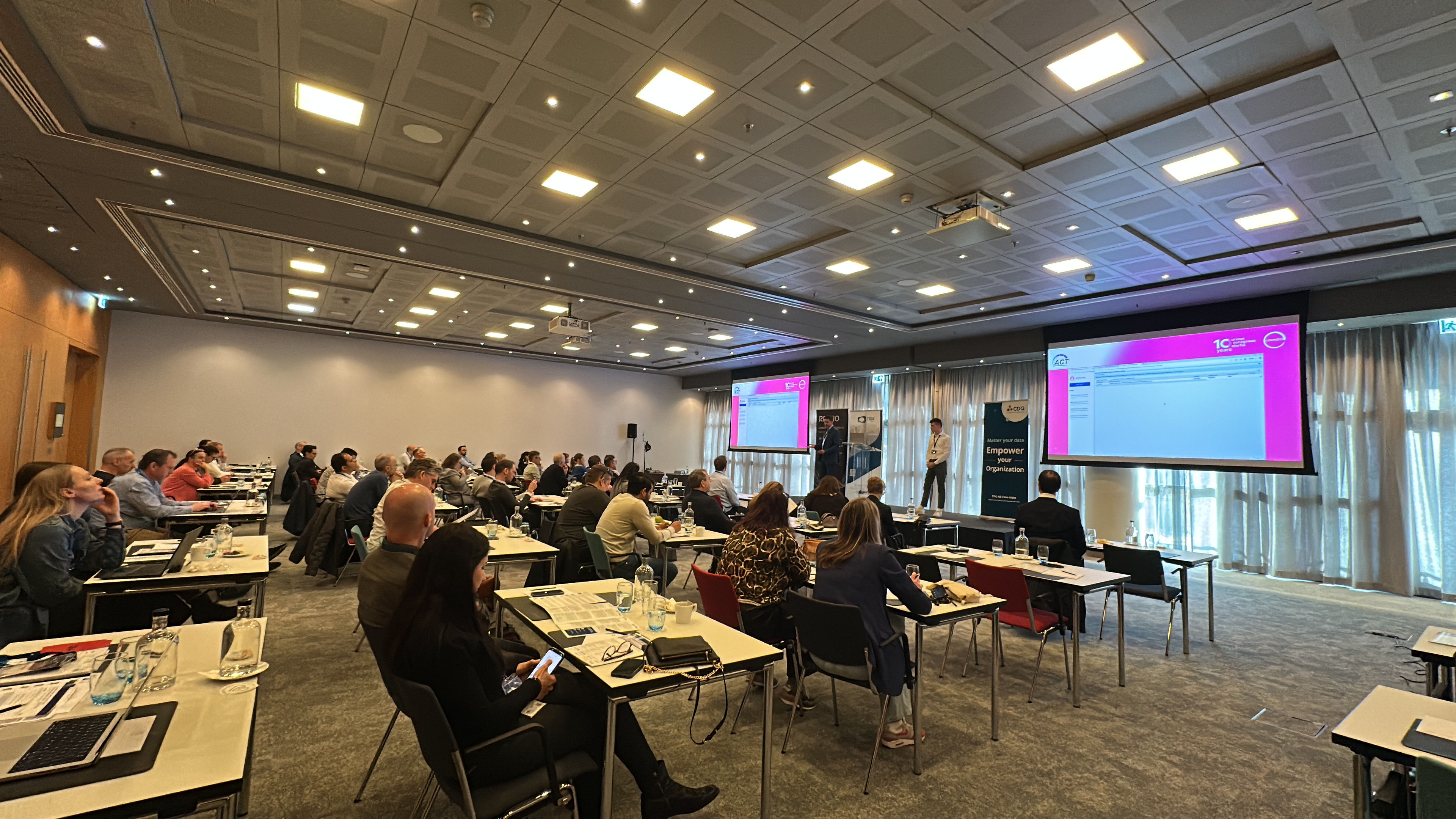
Another striking observation was the diversity of maturity levels represented at the conference. Some organizations shared insights gained from years of experience, including lessons learned from earlier missteps. Others were at the beginning of their journey, looking for orientation and practical starting points.
Despite these differences, the questions being asked were remarkably similar. How do we prioritize initiatives? How do we scale without slowing down the organization? How do we maintain data quality while the business continues to evolve?
This diversity reinforced the importance of community-driven exchange. Peer learning remains one of the most effective ways to move from concept to impact, regardless of where an organization currently stands.
Automation and AI as Accelerators, Not Shortcuts
Artificial intelligence and automation were present in many discussions, but the tone was notably pragmatic.
AI was not framed as a replacement for governance or ownership, but as an accelerator that can amplify existing structures.
There was broad agreement that automation delivers value only when built on trusted data foundations. Without clear ownership, quality standards, and reliable processes, AI simply scales existing problems more efficiently.
This perspective aligns closely with our experience: trusted data remains the backbone for any meaningful automation, compliance initiative, or data-driven decision-making.
Looking Ahead
The conversations in Amsterdam reinforced a clear message. The principles of master data management are well established, but long-term success depends on execution, communication, and the ability to engage people across the organization.
Customer examples such as Covestro’s demonstrated that practical, user-centric approaches can turn data governance into a genuine business enabler rather than an abstract discipline.
For CDQ, the conference once again confirmed the value of practitioner-driven exchange and collaborative learning (this is what we practise on a daily basis with our Data Sharing Community). As organizations continue to strengthen their data foundations, these shared experiences play a crucial role in turning strategy into sustainable practice.



Get our e-mail!
Related blogs

8 Things CDOs should know about cloud data quality
Migrating to the cloud amplifies existing data quality issues. Without proactive governance, bad data multiplies faster across distributed cloud environments,…

What Is AI-Ready Data?
A Practical Definition (and Checklist) for Enterprise Teams. AI-ready data is not the same as clean data, and that distinction is why so many AI initiatives…

One Call Sign, Two Aircraft: Why Identity Is the Foundation of Every Data Strategy
Data governance has one core job: to keep every object an organisation decides on, a customer, a supplier, a product, uniquely identifiable across systems,…