
We're excited to welcome Bayer, Schaeffler, PMI and EnBW in the final round!
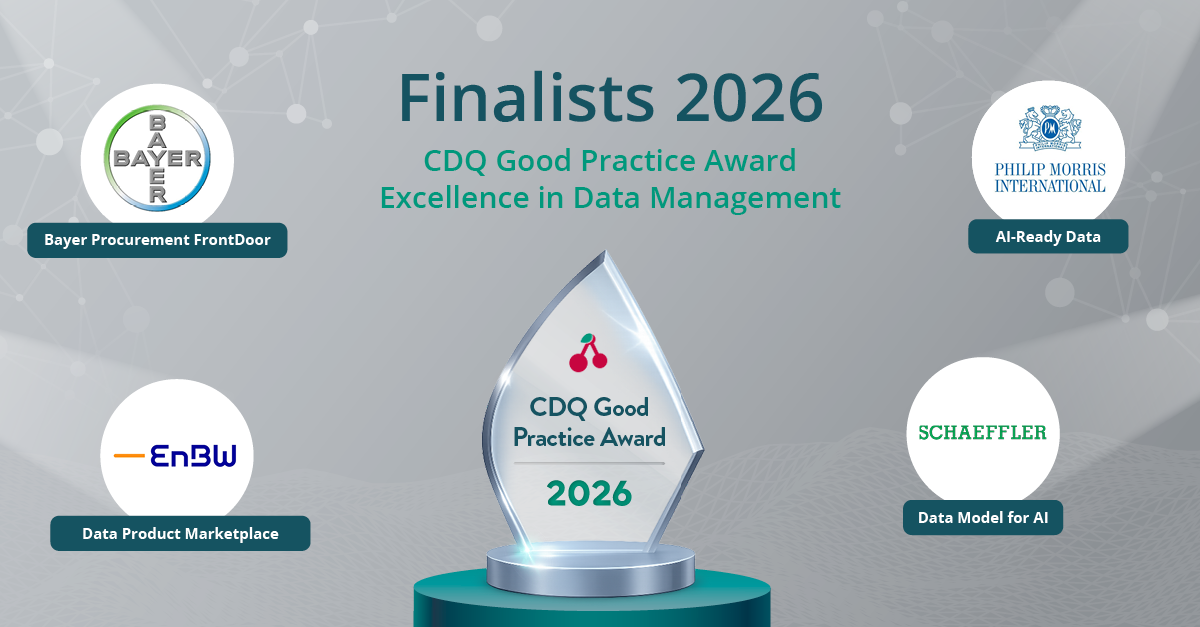
We are delighted to announce the four finalists for this year's CDQ Good Practice Award: Bayer, Schaeffler, PMI and EnBW.
Each of these organizations has demonstrated outstanding innovation and excellence in data management. The finalists will present their good practices to the CC CDQ community during our next workshop on November 25, 2026:
- Bayer: Procurement FrontDoor
- Schaeffler: Data Model for AI
- PMI: AI-ready Data
- EnBW: Data Product Marketplace
The winner of the CDQ Good Practice Award 2026 will be announced during the award ceremony on the evening of the same day.
We would like to extend our sincere thanks to all participants for their excellent contributions and the significant time and effort invested in preparing their submissions. The quality of entries was exceptionally high again this year, making it another neck-and-neck race.
To those who did not make it to the final round: please rest assured that your work and commitment are highly appreciated. The next opportunity to showcase your good data management practices will come soon. Stay tuned for the 2027 CDQ Good Practice Award!
Stay in the data excellence loop:
follow us on LinkedIn!
Meet the finalists and their best practices

Trusting AI Starts with Trusting Data: PMI's Journey to AI-Ready Data Foundations
Artificial intelligence can only be as trusted as the data that shapes its outcomes. Recognizing this, Philip Morris International created AI-Ready Data (AIRD), an enterprise approach designed to make data readiness for AI measurable, actionable and repeatable.
AIRD establishes a shared definition of what AI-ready data means, using 20+ evidence-based criteria across five dimensions and embedding readiness into the AI Governance lifecycle. It helps teams identify data risks and improvement opportunities early, while progressively enabling readiness evidence to be reused across AI initiatives and data foundations.
This case presents PMI's journey from defining AI-ready data to operationalizing and scaling AIRD across the enterprise. It explores how real AI challenges shaped the capability, how readiness evidence can influence decisions, and how PMI is evolving from reactive, use-case-driven assessments toward a more proactive and scalable model.
At its core, AIRD asks a simple question: before we trust the AI, how do we know we can trust the data underneath it?

From fragmented onboarding to governed supplier automation
A machine is down. The supplier is ready. But can we buy? In a large corporation, a simple business need quickly turns into siloed questions: Is the supplier available and enabled? Is it compliant? Who acts next? The result is multiple handovers and days of waiting.
Bayer has chosen a different path: instead of automating the old process, it changes the way buying works. Built on the “Freedom to Spend Smartly” strategy, the FrontDoor platform gives requesters one guided journey. The user brings a supplier quotation, and the platform handles supplier identification, onboarding, risk controls and requisition creation. Trusted external data from CDQ and other providers form the evidence base for automated checks within a risk-based, fail-safe decision model. AI interprets quotations, rules decide, and humans govern exceptions.
FrontDoor already handles about 20,000 purchase requisitions a month and is now connected to the CORE S/4HANA data foundation. An automated supplier onboarding pilot starts in Q1 2027, with clear north-star targets for eligible low-risk cases: a supplier in 10 minutes and a purchase order in one hour.
Guided buying, trusted data, embedded master data management and intelligent automation come together here – making procurement simpler, faster and more reliable.

Data Model for AI: Creating Schaeffler’s AI-ready Data Foundation
The merger of Schaeffler and Vitesco created the need to harmonize different data structures and business vocabularies while building a scalable foundation for AI. Schaeffler addressed this challenge with Data Model 2.0, an enterprise-wide, IT-system-agnostic Data Model that connects business meaning with IT technology and clear accountability. Its Data Objects, Data Products, and standardized management framework make data easier for employees and AI agents to discover, understand, and use responsibly.
Already embedded in key business processes, the Data Model 2.0 promotes reusable data instead of isolated, use-case-specific solutions. It strengthens data quality, transparency and compliance while laying the groundwork for scalable Agentic AI.
Award for outstanding data management initiatives
The CDQ Good Practice Award acknowledges world-class and innovative data management initiatives paving the way for digital and data-driven enterprises. The award is an initiative of the Competence Center Corporate Data Quality (CC CDQ) and the European Foundation for Quality Management (EFQM), supported by a global jury of international data experts from practice and academia.